We find the country that has already solved a problem another one is stuck on, and set out what it would take to adopt that solution.
Our base case is cross-border learning.
For that we rely on our Strategic Intervention Papers.
We live in an age during which individuals as much as nations are grappling with decreasing levels of certainty and an increasing number of challenges.
Tackles national policy problems, finds a country that has solved it successfully, and sets out what adoption requires, including specific steps to be taken.
A short, media-ready take on something that is currently moving the global agenda. It zeroes in on an overlooked angle, challenges conventional wisdom and explains who the people are with an interest in perpetuating it.
Not every cross-country comparison offers itself up for a strategic intervention.
That is why, in addition to the Strategic Intervention Papers, our other trademark editorial approach is our series of Global Pairings features.
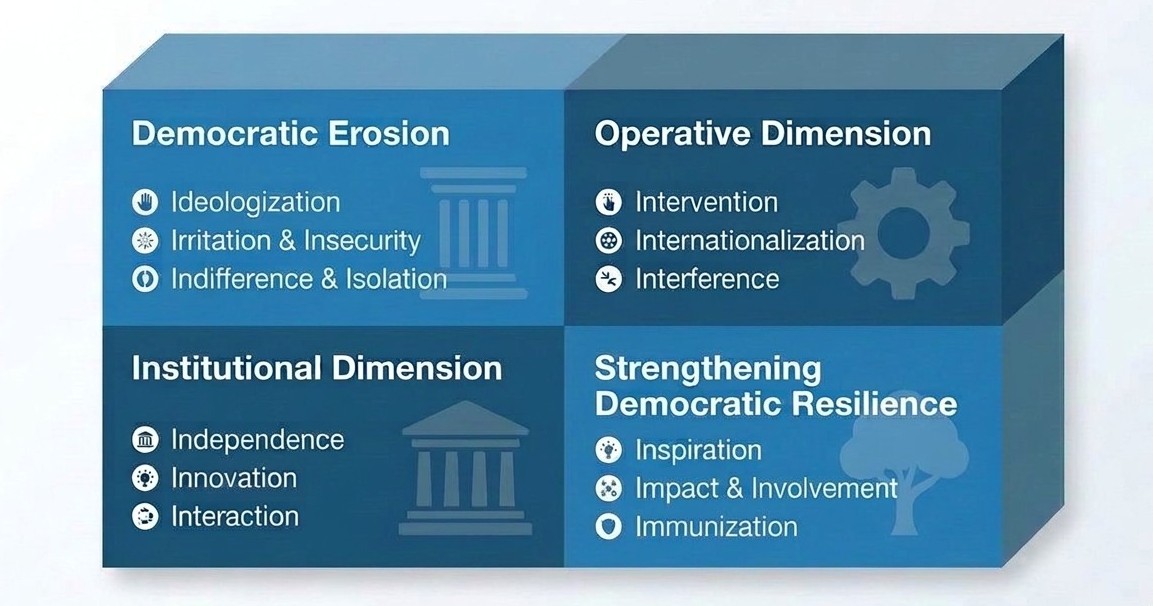
Two questions shape much of our work: Can democratic systems still decide and implement decisions? Or are we doomed to political standstill which erodes democracies?
Openness and accountability of institutions. Transparency, cohesion and the future of Western democracy.
Read on The Globalist →Equitable and environmentally viable growth. Climate resilience, industrial policy, the digital society.
Read on The Globalist →Europe's role in the world, and the relationships between countries that set what is possible inside them.
Read on The Globalist →Values-based cooperation, and whether institutions built for a slower world can still act in this one.
Read on The Globalist →Cohesion, demography, migration, culture, and the social effects of technology.
Read on The Globalist →Risk in its widest sense, security and environment together. The very existence of humans is at risk today.
Read on The Globalist →Currently exploring funding relationships with partners interested in supporting our projects in pursuit of our mission.
Support our work →The Globalist is the GIC's principal publication channel but remains editorially independent.
How funding worksStrengthening democracy starts with solving real problems. And when one country solves a specific problem, it creates a constructive precedent that other democracies may follow. Each Strategic Intervention Paper zeroes in on a political problem the country in focus has stopped trying to solve.
We look for a country that did solve it, and turn that precedent into an evidence-based argument reform blockers have to answer. A SIP’s recommendations always include specific steps to be taken.
In politics, if you are explaining, you are losing. A precedent that already works abroad forces the other side to explain why it would fail at home. Reformers then argue from evidence instead of intention.
We apply what we call The Power of Comparisons™ in five different ways.
The debate moves beyond what is possible in principle to introduce real change.
Legislation, administration and institutions become the unit of argument.
The burden of explanation moves to whoever wants to block a proposed reform.
SAMs are short, media-ready takes about hot items on the global agenda.
A memo begins where someone in power has asserted something as self-evident. It rarely is.
Positions promoted as unassailable wisdom tend to be self-serving and short-sighted. The memo says whose interest the framing serves.
We supply the angle that has been left out, or a framework in which the same facts read differently.
A SAM moves a debate this week. A SIP moves a decision over a reform cycle.
Guest commentary by Stephan-Götz Richter.
We live in an age during which individuals as much as nations are grappling with decreasing levels of certainty and an increasing number of challenges.
But even though today’s world is more globally connected and complex than ever, most nations still limit their national politics to historically familiar patterns. As a result, most nations are constrained by the political economy of their home country and have limited their ability to affect or react to far-flung processes that affect them intimately.
Populists have risen to political prominence around the world by offering false solutions and peddling mantra-like shortcuts to prosperity and success. Their approaches often tend to obscure, rather than help solve, the underlying real-world issues.
Simply put, we live in a world that is shaped by so much complexity that the old faultlines of political ideology — the left and the right — are no longer adequate or useful.
Democracies are currently more challenged, both at home and internationally, than in many decades. That is why we focus on strengthening their resilience.
The Global Ideas Center (GIC) is a non-profit, independent and virtual think tank. It operates a global network of reform-oriented practitioners, academics and civil society actors. Our goal is to apply their insights to critical issues of national and international concern in a solutions- and reform-oriented manner.
The Global Ideas Center often uses cross-border comparisons to model its analyses. The principal purpose is (1) to contribute to improving relations between countries and (2) to highlight specific lessons from individual countries that others might learn from and attempt to implement domestically.
The Global Ideas Center’s mission thus is to catalyze new solutions across countries and societies through “The Power of Comparisons.” The GIC tackles powerful interests and challenges conventional wisdom to drive an open, honest, educated and results-oriented debate.
Our key analytical tool to achieve that is cross-border learning. To overcome political standstill, we look for another democracy that has used a specific reform path to solve the political problem at hand. The case for adopting that solution then rests on evidence — rather than endless political arguments.
The GIC works as a hybrid and online think tank: it addresses the broader public as much as experts, and it operates through a global network rather than a physical institute.
Every project the GIC undertakes is designed from the outset as a communications project. Part of that design is to always take into account the interests of the media that might distribute and amplify each project’s message.
The GIC deliberately relies on the principle of establishing counterpoints to ossified arguments. It strives for originality of analysis and insight to generate lasting attention from the public and the media.
The Global Ideas Center is deliberately organized in a multi-thematic fashion and does not adhere to any political ideology.
The GIC is multi-thematic in scope, operates in a media-oriented manner and publishes the online magazine The Globalist as its own independent think tank publication.
Via its online magazine, the GIC has built up a global outreach network of media partners. Its articles have been published in more than 100 different publications — predominantly the leading national newspapers and magazines — in more than 50 countries.
Our Strategic Intervention Papers, which by their very structure often involve cross-border comparisons, evoke a sense of virtual exploration or (mind) travel. After all, travel is a state of mind. When undertaking it, people are more receptive to observing and embracing fresh ideas than in their home environments.
Our work has been published in leading national newspapers in Europe, North America and Asia — and featured on radio stations around the world. We have been publishing our online magazine The Globalist since January 2000.
To understand what is going on in the world, it is often just as important to take a closer look at the parallels (or the differences) between two countries, regions or continents to better understand what drives their politics, their economies, their societies and their history.
This approach often yields a deeper level of insight than just analyzing a single country, region or continent by itself.
Our work has been published in leading national newspapers in Europe, North America and Asia, and featured on radio stations around the world. We have been publishing our online magazine The Globalist since January 2000.
In the election in Saxony-Anhalt, a decisive element of Germany’s political culture is at stake. The culture of remembrance is an essential part of the preservation of human dignity in Germany. What do we have to do to protect it against hostility and undermining maneuvers from home and abroad?
The AfD dismisses Holocaust memory as a “cult of guilt” and moves against provenance research and the return of Nazi-looted art. The Trump administration pursues a parallel revisionism in the United States. Bindenagel argues that defending universal human dignity now needs a transatlantic realignment carried by the democratic center, civil society and local partnerships.
 J.D. BindenagelFellow, Global Ideas Center · former U.S. Ambassador
inhabitants in Saxony-Anhalt, the eleventh largest German state, and a national test case
the Washington Principles, negotiated by the author on behalf of the U.S. government
artworks returned by the Foundation for Lost Art. More than 80 percent in the last 25 years
new dispute mechanisms: The U.S. HEAR Act, a German court of arbitration, a Bavarian commission
Memorial, Nobel Peace Prize laureate 2022, banned from further work in Russia in April
years of the United States, marked by a speech placing a verse from Genesis in the Declaration
Von Weizsäcker names 8 May 1945 a day of liberation, not of defeat
“Human dignity shall be inviolable.” The AfD would restrict it to “bio-Germans”
the de Csepel family’s fight for a collection held by three Budapest museums and a university
guidelines in the Washington Principles, agreed internationally, legally non-binding
For the sake of transparency, I would like to point out at the outset that I have been personally involved in this issue for over a quarter of a century. On behalf of the U.S. government, in 1998, I negotiated the Washington Principles on Nazi-Confiscated Art. Subsequently, President Clinton appointed me U.S. Ambassador and Special Envoy for Holocaust Issues in 1999. I negotiated agreements on compensation payments for forced labor during World War II, as well as for unpaid insurance policies, Nazi-confiscated art, property restitution and Holocaust-related education, research and remembrance, and the establishment of the Foundation Remembrance, Responsibility and Future. The agreement for survivors of forced and slave labor awarded six billion US dollars from Germany.
That is why I am concerned about the German culture wars, which have flared up again in the run-up to the state elections on September 6 in Saxony-Anhalt.
“A regional election could hand the office of state premier to a party that calls Holocaust memory a cult of guilt.”
Although this is a state election in a state that is only the eleventh largest state in Germany with its 2.12 million inhabitants, the event is being followed with great concern nationally and internationally. It could be the first time the Alternative for Germany (AfD), a party classified as right-wing extremist, has won a majority in a state parliament and could take over the office of prime minister.
In my professional life, I have been able to observe precisely that Germany’s handling of the Holocaust is a fundamental moral pillar of German post-war democracy. I have also come to appreciate the fact that the two topics of German reunification and German historical responsibility have always gone hand in hand within the culture of remembrance.
But now these achievements, as well as the necessary and deeply impressive phase of mature social reflection, are suddenly exposed to a growing danger from right-wing extremist political forces.
By trying to dismiss the memory of the Holocaust as a mere “cult of guilt”, the AfD is attacking the moral foundations of Germany’s post-Holocaust self-image in a direct and elemental way.
By trying to dismiss the memory of the Holocaust as a mere “cult of guilt”, the AfD is attacking the moral foundations of Germany’s post-Holocaust self-image in a direct and elemental way.
As a former negotiator and staunch supporter of the Washington Principles on Nazi-confiscated art, I am particularly outraged that the AfD aims to undermine the German culture of remembrance in order to justify the non-return of works of art stolen by the Nazis.1
“Blocking restitution lets old anti-Semitic stereotypes about wealthy Jews resurface under the cover of budget politics.”
A widespread misconception in this context is that historical failures of the post-war period prevent Germany from dealing comprehensively with its past. Dealing with history is certainly not a panacea against National Socialism, and it is not surprising that völkisch-authoritarian racism persists and has resurfaced in the AfD.
However, current demands for an end to the culture of remembrance must not undermine the promise of “never again”. Its goal is to counteract the resurgence of right-wing extremist ethnonationalism.
Although the movement to identify and return stolen artworks is gaining momentum nationwide, all indications suggest the AfD is focused on blocking these efforts.
As part of its election campaign in Saxony-Anhalt in the fall, the AfD is pleading for an end to what it calls the “unfounded general suspicion of all museum holdings2” and the “artificial maintenance of feelings of guilt.”3
As part of this campaign, the foundation “Foundation for Lost Art” (DZK), which is partly financed by the state government in Saxony-Anhalt, has become a target.
While this budget-focused strategy may not come as a surprise, it allows the AfD to signal a far more radical political intent.
As far as I can tell, the main goal is to perpetuate anti-Semitic stereotypes about wealthy Jews who are supposedly always out to amass wealth (and now want to regain it through restitution). This supposedly amounts to stealing national cultural heritage. In doing so, the AfD is proceeding in a very clever way with its infamous insinuations, which can be denied, at least on a purely rhetorical level.
The campaign in Saxony-Anhalt focuses on the future of the German Foundation for Lost Art (DZK), based in Magdeburg, the capital of Saxony-Anhalt. It is responsible for restituting looted cultural assets and recently reached an important milestone: the 10,000th artwork was returned to rightful owners or their descendants.
More than 80 percent of these restitutions have occurred in the last 25 years.
The restitution of Nazi-looted art is now recognized as an ongoing problem that goes beyond the context of the post-World War II era.
“Three new legal structures now stand between the AfD and its goal of closing the book on Nazi-looted art.”
Recently, three developments have created national dispute settlement mechanisms to not only reaffirm compliance with the 1998 Washington Principles, but to make their implementation more effective.
Classifies Nazi art looting as a violation of international law and extends its scope to collections outside the United States.
A federal body to settle disputes over the return of Nazi-looted art.
Determines the focus of Bavarian provenance research.
These new structures are directly directed against the view of the AfD, which tries to defame the overdue legal consolidation of restitution efforts as manifestations of a “cult of guilt”.
In any case, the AfD’s rejection of provenance research effectively perpetuates National Socialist looting.
What makes the AfD’s position even more disconcerting is the fact that its strategy in dealing with the dark pages of German history mirrors that of Vladimir Putin and his approach to whitewashing Soviet history.
“The AfD calls the Nazi era a footnote. Von Weizsäcker called May 8 a liberation. Germany still has to choose between the two.”
Both the AfD and Putin firmly reject any confrontation with collective guilt or responsibility for murderous, state-directed actions in the past of their respective countries.
Both the AfD and Putin firmly reject any confrontation with collective guilt or responsibility for murderous, state-directed actions in the past of their respective countries.
Thus, Putin refuses to engage in any serious way with the commemoration of Stalin’s victims. Instead, their suffering is deliberately downplayed, their history manipulated by distorted facts, and their memory suppressed. Memorials are being demolished, and any further work by Memorial, the Russian human rights organization that received the Nobel Peace Prize in 2022, was banned in April 2026.
The situation is similar withAfD historical revisionism, as practiced by Björn Höcke and Alexander Gauland, two leading representatives of the AfD.4 They resolutely reject any discussion of the question of collective guilt for Germany’s past. Particularly infamous is the thesis that the Nazi regime is only a “birdshit” in the thousand-year history of Germany.
With suchassertions , the AfD is trying to lower public discourse in Germany to the level of more than 40 years ago. In 1985, Federal President Richard von Weizsäcker acknowledged German responsibility for the crimes committed during the Nazi era in a speech that was groundbreaking for Germany’s post-war historical remembrance.
Von Weizsäcker did so by stating that May 8, 1945 should not be regarded in the history books as the day of Germany’s defeat, but as the day of liberation from the Nazi regime.
On the one hand, developments over the past quarter century are positive. The negotiation of the Washington Principles aims to put an end to Nazi looting, so that the stolen works of art do not indirectly perpetuate the crimes of Nazism.
“Reframing “created equal” as “created in the image of an almighty God” writes secular equality out of the founding promise.”
Today, as the right to return looted art to its rightful owners is reaffirmed, it is recognized that Holocaust-era restitution is not yet complete, and that the passage of time must not prevent the pursuit of justice.
However, regarding the parallels between the anti-democratic activities of the AfD and the Trump administration in the USA, the AfD’s current campaign against the culture of remembrance has a very disturbing, until recently unimaginable, dimension of transatlantic cooperation.
While some AfD politicians in Germany have long actively questioned whether German identity is still linked to the legacy of the Holocaust5 and thus want to unhinge German history, Trump’s government, for its part, has begun a similar project. In its historical revisionism, the Trump Administration is concerned with reinterpreting the core message of the US Declaration of Independence, according to which all human beings are created equal.
But instead of affirming this core statement, there is now an insidious attempt to religiously charge the main statement and reinterpret it to mean that Americans are “all created in the image of an almighty God”. Of course, this sentence is not part of the American Declaration of Independence, but a Bible verse from the Book of Genesis. And above all, it contradicts the country’s deliberate constitutional separation of church and state.
That didn’t stop Donald Trump from claiming in his speech on the occasion of the recently celebrated 250th anniversary of the USA on July 4: “And as our Declaration of Independence tells us, we are all created in the image of an almighty God. And a communist will never say that. That’s for sure.”6
It detaches the justification of the overriding importance of human rights from the universal, secular equality of all human beings and links it directly to a form of religious nationalism.
The purpose of this deliberate misinterpretation is obvious: It detaches the justification of the overriding importance of human rights from the universal, secular equality of all human beings and links it directly to a form of religious nationalism.
The U.S. version of launching a culture war also appears in official documents such as the Executive Order of March 2025 on the “Restoration of Truth and Reason in American History.”7 In the document, the president laments that “the remarkable achievements of the United States” have been undermined by “putting its founding principles and historical milestones in a negative light.”
Trump also criticizes earlier federal efforts to eliminate systemic inequalities. And he classifies movements that advocate for racial equality and gender justice as “destructive ideologies” and “historical reinterpretations” that divide the nation.
While there have indeed been some exaggerated efforts in recent decades to portray U.S. history as “inherently racist, sexist, oppressive, or otherwise insurmountably flawed,” remarkably, the president’s executive order does not merely express his intention to abandon these efforts.
Instead, Trump is using this recent past to legitimize a broad movement in exactly the opposite direction, calling into question the need for appropriate corrective action.
As early as the 1990s, Samuel P. Huntington described his concept of a cultural conflict, in which culture would become the main cause of global conflicts, trumping ideology and economics.
“The fight is no longer between civilizations. It runs straight through the middle of Western societies.”
In a striking update of this approach, promoted by U.S. Vice President J. D. Vance, the civilizational struggle between Christianity and secularism is now taking place — within the West.
The contrast between the two approaches is primarily philosophical and not geographical. The central question is whether societies strive for a liberal, universalist future or pursue an illiberal, ethnonationalist and exclusionary approach.
In fact, the universalism expressed in the American Declaration of Independence is a radical Enlightenment idea. It states that all human beings “are created equal and are endowed by their Creator with certain inalienable rights, including the right to life, liberty and the pursuit of happiness.”
“Rolling back birthright citizenship and dismissing Holocaust memory as guilt culture draw on the same idea of who really belongs.”
In a similarly radical form, the German Basic Law emphasizes the inviolability of human dignity and prescribes that the state must ensure respect for it as a matter of priority. This philosophical concept underlines that human dignity applies equally to all people, regardless of their origin or background.
In contrast, ethnonationalism views the nation as a community passed down through family, religion, and cultural customs. It emphasizes the importance of politics in protecting this heritage from supposed civilizational erasure.
Its appeal lies in fostering a sense of rootedness and ethnic identity, but it tends to limit democracy to individuals who share a certain, often artificial, sense of identity or heritage.
In this sense, important U.S. civil rights laws passed in the 1960s, such as the Voting Rights Act and the Civil Rights Act, represent concrete expressions of the specific culture of remembrance in the United States.
Recent U.S. Supreme Court decisions that aim to overturn these laws are not only legally irresponsible and socially destructive. They are also the constitutional implementation of historical revisionism similar to what the AfD is striving for in Germany, in terms of preventing adequate recognition and reappraisal of the dark phase of Germany’s past.
The most legally potentially far-reaching part of this ethno-nationalist reinterpretation effort was Donald Trump’s vehement effort to repeal the “jus soli” birthright in force in the United States. This principle — that all people born within the U.S. jurisdiction become U.S. citizens, regardless of the nationality of their parents — was recently affirmed by the Supreme Court of the United States.
This is particularly pleasing because the court otherwise complies with Trump’s legal policy wishes in almost all of its decisions.
The interim conclusion is that while the Trump administration is undermining the principles of the US Declaration of Independence, the far right in Germany is opposing the constitutional commitment to human dignity by dismissing the German culture of remembrance as a “cult of guilt”.
The German culture wars inspired by the AfD are in line with J.D. Vance’s idea of tribal supremacy. The AfD’s goal is to reshape German identity in terms of ethnic purity.
The acceptance of the culture of remembrance and the principle of “never again” are both rooted in the belief in universal human dignity. The AfD and its US heroes, Musk and Vance, firmly reject this.
That we are witnessing the erosion of this promise, which was originally made by survivors of Buchenwald and other Nazi concentration camps, starting from the USA of all places, is as worrying as it is shameful.
The fact that we are witnessing the erosion of this promise, which was originally made by survivors of Buchenwald and other Nazi concentration camps, who believed in the universality of human dignity, starting from the USA of all places, is as worrying as it is shameful. It is diametrically opposed to the consistent propagation of human rights by the American side, especially at the international level.
The AfD’s stance against provenance research and looted art restitution is likely to have an impact on other post-communist countries, as they too increasingly have to deal with looting in connection with the Holocaust and perspectives from the pre-1990s period.
The AfD’s approach to reshaping German politics not only calls into question Germany’s politics of remembrance, but also aims far beyond it.
By restricting the concept of human dignity to “bio-Germans” — i.e. mainly white Germans — the party pursues two goals: First, it wants to weaken or devalue the concept of human dignity so that it no longer serves as a cornerstone of the Basic Law.
Second, it aims to undermine the moral foundation of the Western view of the post-Holocaust world legal order, which is fundamentally based on the belief that human dignity is universal and empathy is indispensable.
These basic principles are now under scrutiny, as Elon Musk, for example, questions the value of empathy, claiming that it is the biggest mistake of Western civilization. At the same time, right-wing extremists look at history through a kind of tribal lens and see supporters of universal Human dignity as tyrannical. As regrettable as this view is, it is not unexpected among high-ranking Trump officials.8
For example, Vance reinterprets the Christian concept of “ordo amoris” (order of love) and suggests that one’s own group should take precedence over others, which is contrary to traditional Christian teaching.
Mere knowledge of the Holocaust does not guarantee that “never again” will occur. A central problem is that many people, especially younger generations worldwide, lack sufficient historical knowledge and are increasingly attracted to ethnic or nationalist policies.
“Knowing the history of the Holocaust has never been enough by itself to stop it from happening again.”
Basically, this illustrates more comprehensive deficits in the education system and problems of social development, also in Germany.
Despite the ongoing political upheaval that is shaking the transatlantic alliance, which is primarily based on values, it is crucial to remember one thing. Most people on both sides of the Atlantic still share fundamental interests rooted in values such as freedom, democracy, economic freedom, the rule of law, and human rights.
While political differences in the priorities of the United States and Europe are inevitable, the current disruption of the international order, which is only partly due to rising geopolitical tensions and instability, is self-harming. The simple fact is that, at a time of sustained rise of autocratic regimes, the democratic world cannot afford to be increasingly divided on key issues, especially on issues of values.
“If national governments waver on democratic values, city partnerships and civil society may have to carry the relationship instead.”
Europe continues to recognize the importance of the transatlantic partnership. However, its future prospects should receive greater attention in the American media, which is increasingly focused on purely domestic politics, including scandals and misconduct.
If the West is to have a chance for the future as a community of values, the US media in particular must ensure that they contribute more to a strategic dialogue and a constructive rapprochement in order to counteract Trump’s undermining attacks that he is constantly directing against Western democracies.
This realignment is essential, especially as Canada is inevitably shifting from its constructive transatlantic bridging function to a stronger focus on European relations. After all, this shift in U.S.-Canadian relations reflects the fact that transatlantic relations are no longer as strongly aligned with the US as they have been for decades.
Moreover, defending common democratic values on the other side of the Atlantic increasingly depends on civil society networks and local engagement, in addition to traditional diplomacy and statecraft.
What is crucial is the courage to maintain relations in a way that supports democracy.
The courage required to defend democracy should be supported by a clear understanding of the global strategic environment, which is changing dramatically. Since we live in a hostile world, military and economic strength is also required to ensure our security.
At the same time, rebuilding connections between the U.S. and Europe should focus on local, personal, and community efforts. The future of the transatlantic partnership depends not only on national governments and political leaders, but also more than ever on bilateral relations between State and local officials, sister city programs, and student/labor exchange programs. In cooperation with local foundations, citizens’ initiatives and regional actors, the aim is to involve all social forces that value democratic values, have probably already benefited from them and are also fundamentally committed to protecting them.
It is essential to strengthen relations between societies on both sides of the Atlantic through exchanges, civil society, grassroots movements, culture and science. At the same time, we need to improve the resilience of these relationships so that they can withstand potential disruption from political changes.
The simultaneous efforts of the AfD in Germany and the Trump administration in the USA to undermine a shared values consensus are a warning for us.
In Germany, the AfD’s action against the culture of remembrance is about no longer relying on continued respect for human dignity. In the United States, the Trump administration is pursuing an ethno-nationalist attempt not only to unhinge the universal character of the American Declaration of Independence, but to deny it through “Christianization.”
Ultimately, both are similar forms of historical revisionism that seek to destroy not only their respective national communities of values, but also those of the entire West. All this is taking place at a time when the West is already challenged by autocratic regimes and structural changes in the global economy.
Today, as the right to return looted art to its rightful owners has been widely reaffirmed internationally, it is also recognized that Holocaust-era restitution is not yet complete and that the quest for justice remains a topical task.
“Some governments that demand the return of their own looted heritage abroad have returned almost none of what they hold at home.”
What is particularly worrying about the current situation in Germany is that the attitude of the AfD, which has clearly positioned itself against provenance research and restitution, also has implications for post-communist countries.
For they, too, are increasingly confronted with the question of the return of looted art objects in connection with the Holocaust and with the trivializing view that prevailed in these countries before 1990.
The main barrier to returning Nazi-stolen art in Central and Eastern Europe is also political. Restitution, especially when works are held by public museums, requires governments to confront histories of local collaboration. Several countries, notably Belarus, Hungary, Poland, and Russia, are examples of states that on the one hand advocate the return of national property abroad, but have themselves returned comparatively little property from their national property.
The Soviet Union considered art captured in the Second World War as “spoils of war.” In the 1950s, the Soviets distributed some of them to the satellite states, which considered them public property. Restitution, even when clearly of Nazi-looted art, is a struggle. To give a concrete example: In Hungary, after 1945, David de Csepel’s family began its struggle over 80 years for the return of their historic art collection of paintings, tapestries and Renaissance furniture, which had been stolen by the Nazis. These works are publicly owned by public institutions in Hungary — three museums and a university in Budapest.
It will help decide whether Germany will remain committed to one of the successful chapters of its democratic history and culture of remembrance.
On 6 September, Saxony-Anhalt will therefore not only decide on a state government. It will help decide whether Germany will remain commited to one of its successful chapters of its democratic history and culture of remembrance — or whether it will allow a right-wing extremist party to declare the return of looted art a symbol of alleged “guilt cult” policy, which would probably also have negative consequences for the rest of Europe.
The Washington Principles of 1998 are eleven internationally agreed, legally non-binding guidelines for the detection and return of Nazi-looted art.
They build on the history of cultural property confiscation during the Holocaust to prevent similar acts of violence based on identity. Their focus is on the return of artworks stolen by the Nazi regime to their rightful owners.
All signatories to the Washington Principles recognized the Holocaust as one of the most serious crimes of identity-based violence, which included plans to attack the property rights of those who were to be expelled or killed.
The “Times of London” reports that works of art looted by the Nazis have once again thrown Germany into turmoil. In fact, the looting went far beyond art and included many everyday cultural items such as porcelain, crystal, silver cutlery, jewelry, carpets, and family heirlooms that shaped Jewish culture. This included household items such as clothing, bedding, household appliances, pots, pans, and light bulbs.
Given the scale of the looting, the Washington Principles have always been about more than just the return of cultural property, as a full return to the original owners or families was unlikely for a variety of reasons.
In particular, much of the property was too unspecific to be identified. Nor was European law designed to reverse the consequences of the Holocaust, and postwar governments were generally unwilling to do the arduous work of restitution, even when the facts were still fresh.
In a podcast recorded together with the Münchner Stadtmuseum (“Time Loops: The Restitution Files”), the museum acknowledged the importance of justice for the rightful owners when returning a silver service. The restitution contributes to Germany’s responsibility and culture of remembrance.9
J.D. Bindenagel is a fellow at the Global Ideas Center in Berlin. He has been personally involved in restitution for over a quarter of a century. On behalf of the U.S. government he negotiated the Washington Principles on Nazi-Confiscated Art, and was appointed by President Bill Clinton in 1999 as U.S. Ambassador and Special Envoy for Holocaust Issues. In the course of his diplomatic career he was also deputy head of mission at the U.S. embassies in East Berlin and Bonn, and U.S. Chargé d’Affaires in Germany in the mid-1990s.
The Global Ideas Center is a non-profit, independent and virtually operating think tank. It works in the function of a catalyst with a global network of practitioners and civil society actors in the mode of “co-creation”.
The aim is to make their insights on critical issues of national and international importance visible in the media, politics and the wider public in a solution- and reform-oriented manner, and to strengthen the resilience of our democracies through a well-founded, open and honest as well as result- and value-oriented debate.
Our Strategic Intervention Papers address concrete challenges in a country and seek to overcome the political stalemate by expanding the space of thought and possibility. In this way we want to initiate a public debate in order to find a constructive, future-oriented solution to the accumulated problems.
The Strategic Intervention Papers published by the Global Ideas Center are often based on “The Power of Comparisons”, that is, learning impulses based on cross-border comparisons. The main purpose is to contribute to the improvement and optimization of relations between countries and to identify lessons from other countries that can be used as a constructive impetus for problem solving at home.
In doing so, the GIC regularly questions powerful status quo interests and conventional wisdom, which, in addition to the increasing dysfunctionalities of politics, often bear great responsibility for the current increase in political sclerosis.
Contact: sgr@globalideascenter.orgCurrently exploring funding relationships with partners interested in supporting our projects in pursuit of our mission.
Our work has been supported by a variety of major foundations in the United States and Europe. We are currently exploring funding relationships for our new initiative to strengthen the resilience of Western democracies through the public release of Strategic Intervention Papers.
Global Ideas Center (GIC) gGmbH is an independent tax-exempt non-profit entity under German law, equivalent to 501(c)(3) status in the United States, recognized as charitable by Finanzamt Berlin-Charlottenburg under §§ 51 ff. AO.
Our work has been supported by a variety of major foundations in the United States and Europe. We are always interested in exploring new collaborations.
Cross-border learning is the strategic hinge between most countries’ domestic reform capacity and constructive globalism. It is an important instrument to manage global risks.
Cross-border learning enables states to overcome internal stalemates, identify viable external models and convert those models into the building blocks of overlapping, problem-driven coalitions. For middle powers in particular, this readiness to learn across borders is a key requirement in the new global environment.
Cross-border learning enables states to overcome internal stalemates, identify viable external models and convert those models into the building blocks of overlapping, problem-driven coalitions. For middle powers in particular, this readiness to learn across borders is a key requirement in the new global environment.
Under conditions of superpower unilateralism, middle powers that refuse cross-border learning will struggle to keep their autonomy and may become objects of external will.
Those that institutionalize cross-border learning, by contrast, gain a better chance to shape standards, pool capabilities, strengthen democracy through credible delivery and build the forms of managed interdependence on which constructive globalism depends.
Constructive globalism is a problem-driven strategy to use managed interdependence to tackle risks that nation states face in common, since they are structurally global in character. These include security, public health, digital infrastructure, economic resilience, climate, financial contagion, supply chains and migration.
States need the capacity to identify workable external solutions and adapt them to their respective domestic settings. The overall goal is to embed them in overlapping coalitions and common frameworks.
Constructive globalism is defined as a dense set of issue-specific and voluntary but credible coalitions, organized around concrete problems rather than ideology, variable geometry rather than universal participation and enforceable commitments rather than rhetorical aspiration.
It cannot work without a mechanism that allows states to discover, compare, and adapt successful approaches across jurisdictions. That mechanism is cross-border learning.
Cross-border learning involves the systematic evaluation of experiences and policy approaches made by other countries in their attempts to deal with pressing global issues, and, based on that effort, their translation into domestic reform through means such as policy transfer, diffusion or convergence.
The common objection to this approach is that such learning is technocratic or even consciously depoliticizing. On the contrary, cross-border learning is a deliberate strategy to politicize the effective pursuit of constructive solutions by confronting entrenched domestic interests with the fact that viable policy alternatives exist beyond the given nation’s borders.
This point matters conceptually because it shifts the function of learning from narrow policy optimization to political transformation.
Cross-border learning expands the range of legitimate options in domestic democratic debates, exposes prevailing forms of status quo bias, and, above all, forces political actors to justify why national routines should prevail when comparable democracies have solved the problem more effectively in a different manner.
This approach of combining constructive globalism and cross-border learning is therefore best understood as a deliberate strategy of politicization, which is the opposite of the presumed expert-led insulation from politics with which the term “globalism” is often associated.
The constructive globalism concept rejects the conventional binary choice between globalism and sovereignty. Instead, it frames the real choice as one between managed interdependence and unmanaged vulnerability.
Without cross-border learning, states lack the knowledge to decide which regulatory models, financing structures, institutional designs and policy compromises are robust enough to support cooperation beyond the nation-state.
The relationship between cross-border learning and constructive globalism is especially important for so-called middle powers.
In a world shaped by two superpowers who tend to act unilaterally, middle powers do not possess the scale of the United States or China, nor can they secure prosperity, technological relevance or strategic autonomy by relying exclusively on domestic market size or coercive leverage.
These states have a powerful incentive to deepen cross-border learning. It helps to prevent them from becoming mere objects on the global stage. Indeed, it is no exaggeration to say that under contemporary geopolitical conditions, the readiness to engage in cross-border learning is the conditio sine qua non for success of the middle powers.
Their task therefore is to build coalitions, pool capabilities, establish regulatory credibility and translate foreign policy, economic policy and other such domains into both domestic reform and international cooperation.
The measure of their power is their ability to aggregate capabilities with partners.
For that reason, middle powers must constantly ask themselves which combinations of policy, regulation, finance and institutions have worked elsewhere, how those combinations can be adapted domestically, and how they might become the basis for wider clubs, compacts and norms.
If, instead, middle powers remain trapped in the inherited patterns of their respective national political economies, they are bound to face strategic drift. An external environment that is constantly becoming more coercive and less rule-bound will dramatically raise the price these nations have to pay for participation on the global stage.
The stakes in the present moment are high, and the incentive for middle powers to look across borders for common approaches has rarely been greater. Middle powers must coordinate, compare and learn to remain capable of shaping outcomes.
Europe provides the clearest example of both the necessity and the difficulty of this logic. The European Union can no longer afford to remain trapped in 27 separate (non-)reform logics if it wishes to compete with the United States and China, maintain prosperity and preserve its capacity to act.
That is why cross-border learning is no longer a "nice-to-have," but a prerequisite for the realpolitik implementation of the European deal.
There is no question that this is difficult to bring about. National identity discourses, path dependencies, domestic coalitions and fears of "foreign" models routinely prevent the adaptation of proven solutions from neighboring democracies.
The result is a persistent implementation deficit: Europe often diagnoses its structural problems accurately but lacks the political capacity to move from diagnosis to reform.
This matters strategically, because Europe long conceived of itself as a giant on the world stage. Yet when cohesion continues to be rather weak and economic growth is insufficient, even such a presumed geopolitical giant increasingly risks becoming an object rather than a shaper of global order.
In that sense, Europe’s current predicament is less an internal governance problem than a geopolitical warning about what happens when a large economic area fails to institutionalize cross-border learning with enough seriousness.
Crucially, Europe’s vulnerability does not stem only from being exposed to harsh external pressures. It also stems from its lack of ability to turn internal diversity into an effective mechanism of collective learning and therefore into collective power.
Constructive globalism offers middle powers a way to escape effective self-degrading on the global stage by turning cross-border learning into a strategic method.
This is true inside Europe, but it also applies beyond it. Countries such as Canada, Japan and South Korea face comparable structural conditions. In and by themselves, they are wealthy, capable and institutionally sophisticated countries.
Yet they operate in a geopolitical environment increasingly shaped by superpower rivalry and unilateralism. Their ability to avoid subordination depends on domestic adaptation and external coordination, including with partners beyond their immediate region.
Constructive globalism is attractive to such states because it does not require universal consensus or the preposterous assumption of a world government. It relies instead on overlapping coalitions, pragmatic governance and mutual self-interest.
But for these arrangements to become durable and substantive rather than rhetorical, participating states must reshape their domestic political culture to one that treats learning from other countries as a mark of responsibility and strength rather than weakness.
The pursuit of cross-border learning is a precondition for constructive globalism. If done successfully, this requires shared analytical frameworks, peer review, systematic evaluation of reform pathways and public-facing case studies that translate external knowledge into domestic political debate.
Credible, interoperable frameworks and issue-specific coalitions should reduce uncertainty and enable practical cooperation on common risks.
Taken together, this framework suggests that middle powers require a distinct learning infrastructure. Such an infrastructure includes comparative policy analysis, mechanisms for adaptation rather than imitation, elite and public narratives that legitimate learning, as well as transnational forums in which solutions can be tested, contested and scaled.
Without these components, constructive globalism will remain too thin to resist either neo-national fragmentation or domination by superpowers.
The democratic dimension of this undertaking is central. If democracies continue to promise what constrained budgets and weak growth cannot deliver, public trust will erode further.
Cross-border learning offers one response because it increases the chance that reform agendas are grounded in tested solutions rather than domestic wishful thinking, while also making it easier to demonstrate the tangible benefits of external cooperation to citizens.
At a time when the world agenda is overshadowed by great-power competition, globalism has become more relevant than ever before. Guided by the twin principles of mutual learning and cross-border learning, it offers the antidote to neo-nationalism and anti-capitalist nostalgia.
The real choice facing nations today is not between “globalism” and “sovereignty,” but between managed interdependence and unmanaged vulnerability. The claim that globalism aims to create the conditions for world government is a deliberate rhetorical diversion to evade that choice.
Strategic Intervention Papers (SIPs) are designed to identify a specific problem facing a nation or set of nations and to launch a broader, future-oriented public debate aimed at solving it. Two essential features distinguish a SIP from ordinary commentary.
Either between two countries in the same period, or between a contemporary country and an earlier version of itself.
Usually a reform to adopt. Strategic interventions may also identify a solution to destructive actions designed to undermine Western democracies from without, and complicity with such attempts from within.
Not every cross-country comparison offers itself up for a strategic intervention.
That is why, in addition to the Strategic Intervention Papers, our other trademark editorial approach is our series of Global Pairings features.
To understand what is going on in the world, it is often just as important to take a closer look at the parallels (or the differences) between two countries, regions or continents to better understand what drives their politics, their economies, their societies and their history.
This approach often yields a deeper level of insight than just analyzing a single country, region or continent by itself.
Cross-border learning is the strategic hinge between most countries’ domestic reform capacity and constructive globalism. It is an important instrument to manage global risks.
Cross-border learning enables states to overcome internal stalemates, identify viable external models and convert those models into the building blocks of overlapping, problem-driven coalitions. For middle powers in particular, this readiness to learn across borders is a key requirement in the new global environment.
Cross-border learning involves the systematic evaluation of experiences and policy approaches made by other countries in their attempts to deal with pressing global issues, and, based on that effort, their translation into domestic reform through means such as policy transfer, diffusion or convergence.
The common objection to this approach is that such learning is technocratic or even consciously depoliticizing. On the contrary, cross-border learning is a deliberate strategy to politicize the effective pursuit of constructive solutions by confronting entrenched domestic interests with the fact that viable policy alternatives exist beyond the given nation’s borders.
Cross-border learning expands the range of legitimate options in domestic democratic debates, exposes prevailing forms of status quo bias, and, above all, forces political actors to justify why national routines should prevail when comparable democracies have solved the problem more effectively in a different manner.
The democratic dimension of this undertaking is central. If democracies continue to promise what constrained budgets and weak growth cannot deliver, public trust will erode further. Cross-border learning increases the chance that reform agendas are grounded in tested solutions rather than domestic wishful thinking.
{{SIP_STAND}}
We prepare every Strategic Intervention Paper for publication and place it through media work: Opinion pieces, interviews, explanatory formats, broadcast.
A paper that only reaches people who already agree has not intervened in anything.
In preparing a Strategic Intervention Paper, the GIC applies the comparison in one of five ways, in order to frame the strategic relevance and pinpoint the specific purpose of the intervention. The Good, the Bad, the Ugly, and two forms that sit between them.
The real choice facing nations today is not between globalism and sovereignty. It is between managed interdependence and unmanaged vulnerability.
Constructive globalism is the strategy for the first: a dense set of issue-specific, voluntary but credible coalitions, organized around concrete problems rather than ideology, with variable geometry rather than universal participation.
That strategy cannot work without a mechanism that lets states discover, compare and adapt successful approaches across jurisdictions. That mechanism is cross-border learning, and it is what our papers are built to supply.
The standard objection is that comparative work is technocratic, or that it quietly depoliticizes a conflict. The opposite is true. Cross-border learning confronts entrenched domestic interests with the fact that viable alternatives already exist beyond the national border.
It widens the range of legitimate options in a democratic debate, exposes status quo bias, and forces political actors to justify why national routines should prevail when a comparable democracy has solved the problem more effectively.
Refusing to learn is not a cost-neutral act of democratic self-defense. It has a price, and someone pays it.
Middle powers do not have the scale of the United States or China, and cannot secure prosperity or strategic autonomy through domestic market size or coercive leverage. Their power is measured by their ability to aggregate capabilities with partners.
Under conditions of superpower unilateralism, those that refuse to learn across borders struggle to keep their autonomy. Those that institutionalize it gain a better chance to shape standards, pool capabilities and strengthen democracy through credible delivery.
Europe is the clearest test case, and the hardest one. A union that wants to hold its own against the United States and China can afford less every year to remain stuck in 27 separate reform logics. Its problem is rarely diagnosis. It is the political capacity to move from diagnosis to reform.
We look out for a policy solution another democracy has already adapted to solve a given political problem.
We expose raw-power intimidation aimed at narrowing a democracy’s freedom of maneuver.
We expose patterns of collusion, both from within democracies as well as from abroad, aimed at undermining Western values.
We name a case, domestic or cross-border, where a democracy is clinging to an assumption that will not hold.
We challenge a constraint a democracy has accepted as fixed, when it is not.
Sources: Stephan-Götz Richter, “The GIC and its Five Types of Strategic Interventions,” internal memo, 25 August 2026; the strategy papers linked above. Example papers are cited as named by the author; four of the five are not yet drafted and are marked as placeholders throughout the site.
Angaben gemäß § 5 DDG
Global Ideas Center (gic) gGmbH
c/o Stephan-Götz Richter
Keithstraße 10
10787 Berlin
Deutschland
Stephan-Götz Richter, Geschäftsführer
Ist ein Geschäftsführer bestellt, so vertritt er die Gesellschaft allein. Sind mehrere Geschäftsführer bestellt, wird die Gesellschaft gemeinschaftlich durch zwei Geschäftsführer vertreten.
E-Mail: sgr@globalideascenter.org
Eintragung im Handelsregister
Registergericht: Amtsgericht Charlottenburg, Hardenbergstraße 31, 10623 Berlin
Registernummer: HRB 229270 B
Tag der Eintragung: 10.05.2021
Stammkapital: 25.000,00 EUR
Die Gesellschaft verfolgt ausschließlich und unmittelbar gemeinnützige Zwecke im Sinne des Abschnitts „Steuerbegünstigte Zwecke“ der Abgabenordnung. Zweck der Körperschaft ist die Förderung der Erziehung, Volks- und Berufsausbildung (§ 52 Abs. 2 Nr. 7 AO), internationaler Gesinnung, der Toleranz auf allen Gebieten der Kultur und des Völkerverständigungsgedankens (§ 52 Abs. 2 Nr. 13 AO) sowie des demokratischen Staatswesens im Geltungsbereich der Abgabenordnung (§ 52 Abs. 2 Nr. 24 AO).
Anerkannt als gemeinnützig durch das Finanzamt Berlin-Charlottenburg.
gemäß § 18 Abs. 2 Medienstaatsvertrag (MStV):
Stephan-Götz Richter, Anschrift wie oben.
Als Diensteanbieter sind wir gemäß § 7 Abs. 1 DDG für eigene Inhalte auf diesen Seiten nach den allgemeinen Gesetzen verantwortlich. Nach §§ 8 bis 10 DDG sind wir als Diensteanbieter jedoch nicht verpflichtet, übermittelte oder gespeicherte fremde Informationen zu überwachen oder nach Umständen zu forschen, die auf eine rechtswidrige Tätigkeit hinweisen. Verpflichtungen zur Entfernung oder Sperrung der Nutzung von Informationen nach den allgemeinen Gesetzen bleiben hiervon unberührt. Eine diesbezügliche Haftung ist jedoch erst ab dem Zeitpunkt der Kenntnis einer konkreten Rechtsverletzung möglich. Bei Bekanntwerden von entsprechenden Rechtsverletzungen werden wir diese Inhalte umgehend entfernen.
Unser Angebot enthält Links zu externen Websites Dritter, auf deren Inhalte wir keinen Einfluss haben. Deshalb können wir für diese fremden Inhalte auch keine Gewähr übernehmen. Für die Inhalte der verlinkten Seiten ist stets der jeweilige Anbieter oder Betreiber der Seiten verantwortlich. Die verlinkten Seiten wurden zum Zeitpunkt der Verlinkung auf mögliche Rechtsverstöße überprüft; rechtswidrige Inhalte waren zu diesem Zeitpunkt nicht erkennbar. Bei Bekanntwerden von Rechtsverletzungen werden wir derartige Links umgehend entfernen.
Die durch die Seitenbetreiber erstellten Inhalte und Werke, einschließlich der Strategic Intervention Papers, Strategic Assessment Memos und Grafiken, unterliegen dem deutschen Urheberrecht. Die Vervielfältigung, Bearbeitung, Verbreitung und jede Art der Verwertung außerhalb der Grenzen des Urheberrechtes bedürfen der schriftlichen Zustimmung der jeweiligen Autorinnen und Autoren beziehungsweise der Organisation.
Global Ideas Center (GIC) gGmbH, Keithstraße 10, 10787 Berlin, Deutschland. E-Mail: sgr@globalideascenter.org. Weitere Angaben im Impressum.
Sie haben jederzeit das Recht auf Auskunft (Art. 15 DSGVO), Berichtigung (Art. 16 DSGVO), Löschung (Art. 17 DSGVO), Einschränkung der Verarbeitung (Art. 18 DSGVO), Datenübertragbarkeit (Art. 20 DSGVO) sowie Widerspruch (Art. 21 DSGVO). Sie haben zudem das Recht, sich bei einer Datenschutz-Aufsichtsbehörde zu beschweren; für Berlin ist dies die Berliner Beauftragte für Datenschutz und Informationsfreiheit.
Beim Aufrufen unserer Website erfasst unser System automatisiert Daten wie IP-Adresse, Datum und Uhrzeit, verwendeter Browser, Betriebssystem sowie die aufgerufene Seite (Server-Logfiles). Rechtsgrundlage: Art. 6 Abs. 1 lit. f DSGVO. Speicherdauer: [z. B. 7 Tage — mit dem Hoster klären]
Diese Website wird bei [Hosting-Anbieter] gehostet. [Falls zutreffend: Es besteht ein Auftragsverarbeitungsvertrag gemäß Art. 28 DSGVO.]
Wenn Sie unseren Newsletter abonnieren, verarbeiten wir Ihre E-Mail-Adresse zur Zusendung. Rechtsgrundlage: Art. 6 Abs. 1 lit. a DSGVO (Einwilligung, Double-Opt-in). Die Abmeldung ist jederzeit über den Link in jeder Newsletter-E-Mail möglich. Versanddienstleister: [Anbieter und Speicherort benennen]
Unsere Strategic Intervention Papers und die Grundlagenpapiere stehen ohne Registrierung und ohne Abfrage personenbezogener Daten zum Download bereit. Es werden hierfür keine Daten erhoben.
[Derzeit nicht zutreffend. Sobald ein Zahlungsdienstleister eingebunden wird, ist hier zu ergänzen, welche Daten dort erhoben werden und welche wir zur Ausstellung einer Spendenbescheinigung erhalten. Rechtsgrundlage dann Art. 6 Abs. 1 lit. b und c DSGVO.]
Technisch notwendige Cookies halten die Website funktionsfähig. Nicht notwendige Cookies werden ausschließlich mit Ihrer Einwilligung gemäß § 25 Abs. 1 TDDDG in Verbindung mit Art. 6 Abs. 1 lit. a DSGVO gesetzt. Ihre Einwilligung ist jederzeit über die Cookie-Einstellungen widerrufbar. Eingesetztes Analysewerkzeug: [benennen, z. B. Matomo]
[Jedes Element einzeln aufführen, das von einem fremden Server geladen wird — Schriften, eingebettete Audiodateien, Videos, Karten. Jedes überträgt die IP-Adresse an den jeweiligen Anbieter. Empfehlung: Schriften lokal einbinden, dann entfällt der Punkt.]
Wir behalten uns vor, diese Datenschutzerklärung anzupassen, damit sie stets den aktuellen rechtlichen Anforderungen entspricht.
Stand: September 2026. Diese Fassung ist ein Entwurf auf Basis eines allgemeinen Templates und ersetzt keine Rechtsberatung.
Five areas, each with one name across menu, title and address. Clicking opens the corresponding demo page.
| Level | Today | Proposed |
|---|---|---|
| Top bar | none | Globalist reference, language, newsletter, search |
| Main menu | 8 equally ranked items | 4 areas plus one action button |
| Homepage | pointer to external archives | thesis, comparison block, formats, papers, topics, funding |
| Formats | running text on a collection page | one page holding both explainers and the comparison |
| Homepage device | one fixed country pair, implying every SIP is a learning story | an animated carousel across all five intervention types, autoplaying, pausable |
| Archive | filters by format and field only | a third filter by intervention type, badge shown on each card |
| People | separate page, weighted to former fellows | a section of About, current Fellows first |
| Archive | none | own archive, filterable by format and field |
| Footer | quick links, no year | four columns, newsletter, year, three-color bar |